
INT. ROOM IN A BLACK BOX, Project Room, Gallery VER, (Bangkok, 2020)
Do we see it object? objects?
I pushed one side of the door to let myself in. Before I entered I had no idea about the darkness, the glass window from the outside reflected nothing from the inside. The only reflection I saw is of myself. I could barely see a thing, but I still knew it was a dark room as I passed through. Without entering would I have thought of a room as a mere concept, a concept to enter much like the space itself. I stay for a few minutes longer just to acclimate my eyes. Then I see the slices of light reflected on the floor, the wall and the ceiling. I think, perhaps, if there is no reflection of the light, there will be a room no longer either.
Four walls, a ceiling and a floor and really nothing else. According to the sun, the wall from my right hand side reveals its clearest texture, a very dull black wall painted with the cheapest wall colour with a strong chemical odour. The black wall on the opposite of my gaze appears only in small segments, a darker grey tone it seems, and the wall on the left is what the eyes neglect, it is there to justify the perspective. The ceiling is revealed only in the perception that there is no light from above, a function of a roof. And last, the floor that the eyes cannot actually see but feel. The floor invited the body to stay and observe. It insisted the body as the subject of the room.
Int. A room in a black box, is a self dissection, an autopsy of the double body of the Subject. Of one which is represented and one that bears the unconscious responsibility which makes the representation. In a film there are always two subjects touched by light, one which makes legible the distanced Subject and one which is reflected in the eye of the other. It is an interplay of gazes, that of the maker and that of the spectator turned witness. They have become witnesses in so far that to commit to an act of seeing, is a compromise on one’s body. There is a thin line that separates seeing and making. There is no going outside of the room anymore, the set never finishes and the solid ground never starts.
I stand there waiting for the film to be complete as the sitter is waiting for his portrait.

AMOR2565
We [me/ Joaquin/ Ruggi] were inspired by the color theme since it was the autumn time, the intensity of light makes everything so rich. I construct the shooting plan using colors as a guideline, the main character is Ruch, I worked as a director and Joaquin operated the camera. Besides, we tried to play along with the body movement and the in camera editing technique. Working with super8 is about the eye that relate to the body movement; the cameraman embodied the camera while moving physical body into space, and automatically the eye function as a monitor, framing and composing the movement. Mainly theme we played along was about colors in nature, natural light in relation with a human being. In between the shooting process I came up with the new idea inspired by the form of mushroom that resembles male phallic. I told them about the pornography subject relating to our intimacy, and they agreed to make it together. The last day before heading back to capital I returned the ring I kept for 9 years by passing it to Ruch, it was a very vulnerable moment for all of us, at the moment I was liberated from my past memory. I was resurrected.


16 mm
duration 3 mins

installation view from the 2nd floor, Blind space project Bkk
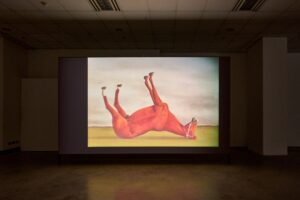 The painting of Sallie Gardner galloping backward into the sunset,
chapter #001, the horse in motion
Video installation as a part of group exhibition at BUG, Bkk [2024] running times 12:02 [year of production 2021]
The painting of Sallie Gardner galloping backward into the sunset is an enactment of different modes of cinematic time through the eyes of the first cinematic subject, Sallie Gardner the horse.
Sallie’s run was to become the first run of cinema, photographed by Eadward Muybridge with the patronage of Leland Stanford on June 15, 1878. On those tracks in Palo Alto was the birth of the moving image with the photographs actually triggered by Sallie’s own gallop coming into contact with tripping wires connected to the camera. This project accesses cinema’s use of time to understand its own medium. The primary subject of cinema becomes then this ongoing conversation with Sallie and the events leading up to that fateful day and after.
Running through both my own narrative as well as that of cinema’s history. Passing by the utilization of this technology by Stanford to develop the transcontinental railroad as well as to optimize the factory mode of production. The horse reduced by modernism as a metaphor for power and production is used time and time again to deconstruct space and time, both in the realm of cinematic representation and the field of transportation.
Recounting these tales, the project liberates Sallie through layered fictions and encounters which bypasses traditional narratives of time. An accident on a train which pushes Eadward Muybridge into an artist obsessed with stopping time is weaved with a capitalist attempting to accelerate it, with Sallie at its centre. The development of cinema is a tangled history which deconstructs time and loops it into itself.

THE WINDOW
part of Speedy Grandma Centennial, Speedy Grandma
(Bangkok, 2020)
Is looking, a making of references?
The work that only refers to experience, perception, intuition, abstraction
Is it about… looking at something that you don’t really know what it is? An out of focus vision? The thing that both makes sense and doesn’t.
There are different perspectives
A mysterious state of being like a ghost
Like when one ask for the existence of ghost, the point of the quest is not the answer itself but the potential for the question embodied in the mystery.
The same as when looking at the abstract painting, the focal point will never be one but infinity, like imagine when looking at the sky to catch the unidentified object.
I ask again the question, what is the meeting ground between ufos fanatic and the obsessed abstract painter?
When one tried to look at the field of blue to see a mysterious light from a higher power, and another looks at a shade of the same color to see the universal mark of man. They are both negotiate with unclear figure at the behest of another entity.
To answer about making, I said..
The making of a reference responded to our need for meaning and therefore, our construct of reference is a need to create meaning by association leads to the making of reference. It is in the end a fiction, the drive of narrative, a need to position ourselves in time and contest that makes a reference relevant.


[UPPER] Full script is available upon the print procession
[LOWER] Photograph of oil on canvas(55x44cm) as shown in space
